Sunday, November 8, 2009

Access to Non-standard Dialects

There are many advantages resulting from keeping access to non-standard dialects open. This access gives society a way to celebrate the richness of diversity of a language. Non-standard dialects are not appreciated, but stigmatized. People speaking in the non-standard variety are quickly associated with a less educated or an economically poor background. Keeping access open eliminates the favoring of only those who speak the standard variety. When access to non-standard dialects are closed, the standardization process of the language norm further separates people into socially identifiable groups, those with prestige and those without. Society must embrace these non-standard varieties if its citizens are to feel any type of pride in their natural speech.

As favorable as it may be to keep access open, it is not practical. In order to get anywhere in this society one must have the ability to "fit in." As we have discussed in WRIT140, it is highly unlikely that the United States would elect a president into office with a thick Southern drawl or a tough Bronx accent. To put it plainly, we (as a society) vote for the person who best represents the USA - a standard English dialect is usually must. It is debatable whether or not keeping access open is even possible. Some may say that everyone could just be left to speak their personal dialects of English. A plethora of questions come to mind, the most prominent being: how will anything get done? In my opinion, the best way to tackle the issue of open/closed access to non-standard dialects is to:
1. Emphasize that all dialects of English have important values and cultures stored within them.
2. Suggest standard English as a sort of lingua franca shared by all non-standard dialects.
3. Enforce standard English as the dialect to use in most affairs dealt with outside of the home, especially in business and government. A look at history can tell us that those speaking standard English generally tend to be more successful.

Summing Up
While society should embrace every dialect for the unique perspectives they add to our daily life, practicality suggests that speaking the standard dialect increases success rate.

Sunday, November 1, 2009

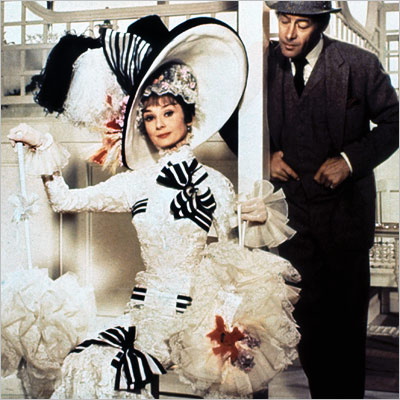
My Fair Lady

My Fair Lady follows the story of a young Cockney-speaking flower girl, Eliza. After hearing her ghastly misconstruing the English language, Professor Higgins claims he can transform her into a duchess. The fact that Higgins assumes his dialect of English is correct and every other one is wrong suggests that there can only be one "right" or "true" language and all others are inferior. The claim that correcting Eliza's language can turn her into a duchess implies there is a connection between proper English and high society. Wanting to be more than a common flower girl and run her own shop, Eliza seeks Higgins and dares him to make good on his offer.

Threatening her with starvation, Higgins forces Eliza through countless, insensitive drills to refine her speech. Among these were constant repetition of her vowels, "the rain in Spain stays mainly in the plain," "in Hertford, Hereford, Hampshire, hurricanes hardly ever happen," and general speaking with marbles in her mouth. This harsh and unnecessary treatment is a caricature of the hard work and suffering that goes into learning a new language. Once Eliza has "mastered" the language, Higgins and his colleague take her out to the races - a taste of real high class society.

Restricted to speaking of weather and health, Eliza stumbles her way through her first "proper" conversation. She passes of her mistakes as the new small talk and manages to snag the attention of a particular Freddie Eynsford-Hill. However, once Eliza becomes involved and excited in the race, she unconsciously reverts back to her loud Cockney self. This illustrates that once Eliza actually felt something, she went back to the language that she felt comfortable expressing herself in.

At the end of the film, Eliza is passed off as a duchess but she remains unhappy. Although she looks the part, there lacks substance. The movie as a whole suggests that gaining a language to fit in with society is not all positive gain. Eliza had to give up part of herself in throwing away her Cockney accent. The real question posed is whether the benefits of relinquishing a language or dialect outweigh the consequences.

Our Green Future: America’s Young Environmental Leaders Speak Out

Three Brower Youth Awardees were featured in the second of the two-part USC "Speaker Series," presented this past week.

First up was Rachel from Berkeley. She started off with poor footing, showing students a video produced by UCLA about USC's C+ sustainability grade. Most of her presentation dealt with her and her accomplishments, complete with the "ra-ra, if I can do it, so can you" pep talk. I wasn't really surprised at USC's grade, seeing as places such as New/North don't even have recycle bins easily accessible. However, problems such as these have a fairly simple solution. I do agree with her statement claiming "we are the most powerful stakeholders on our campus."

Next up was Billy from Yale. Of all three speakers, I feel as though his was more organized and informative. He started with a shocking fact: A certain glacier in India could be gone by 2030, a glacier that 5 million people rely on for their source of fresh water. I liked that he actually defined all of the "go-green" terminology, whereas others often throw this jargon at their audiences and move on. He spoke of the building blocks needed to rebuild the green economy:
-Reinvesting financial capital
-Preserving natural capital
-Maximizing human capital
He was an interesting presenter, probably aided by his use of powerpoint.

Last but not least was Erica from Stanford/Oxnard. Her story was a bit more compelling, perhaps due to its personal connection to her life. She brought up several interesting points, such as the fact that voices are more powerful than money. She spoke a lot about finding your voice, and how educating yourself is the first step. Finally, she mentioned that small things make a difference in thinking globally.

Overall, I feel like this presentation was much more informative than the first. The speakers were younger, which made their speeches easier to relate to. Even though I feel like I learned a bit more about the efforts being made to strengthen the global economy, I will continue to reduce, reuse, and recycle and consider my civic duty complete.

Wednesday, October 14, 2009

All in Favor of an Apology...

There is only so much an apology can do. It cannot erase the past or undo the harm that's been done. In the case of the Aboriginals of Australia, a simple "I'm sorry" went a long way. Prime Minister Rudd's apology proves that people admit wrongdoings occurred and genuinely feel remorse for the hate crimes. An apology, especially from someone as iconic as the prime minister, is the first step in mending relationships between the Aboriginals and the rest of Australia. Mixed responses following Rudd's apology show that the indigenous Australians had more positive feelings or their feelings did not change at all. According to a local Australian poll, gratification and relief were the most popular emotions that Rudd's plea evoked. This solidifies that an apology, if done correctly, never hurts.

Friday, October 9, 2009

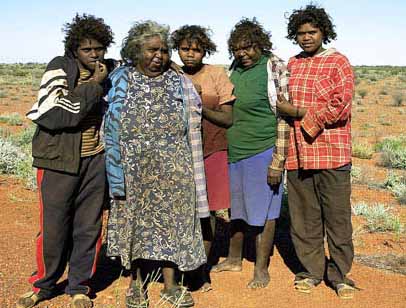
Dear Aboriginals: We're sorry.

Australia was populated by a dispersal of humans who left Northeast Africa, sometime around 50,000-100,000 years ago. This dispersal was probably not a case of planned expeditions like the European colonization, but rather small movements of hunter-gatherer-fisher communities played out over prolonged time periods. This "dispersal of humans" became known as the Australian Aborigines/Aboriginals or "black" Australians. Similar to the segregation seen in the Unites States during and after the era of the slave trade, a large history of mistreatment dating back to the 1800s is found in the history of the Aboriginals in Australia. Perhaps the saddest bit of history in the unfair treatment of Aboriginals is that of the Stolen Generation.

This term is used to describe those children of Australian Aboriginal descent who were removed from their families by the Australian Federal and State government agencies and church missions, under acts of their respective parliaments. According to federal policy, the Stolen Generations were taken from their homes and communities ‘for their own good’. Some white Australians believed that it would be beneficial for Aboriginal children with some ‘white blood’ to grow up in a white society. The goal was to eventually assimilate all Aboriginal children into white society. While it is unclear exactly how many children were taken from their homes, some estimate that the numbers could be between 1/3 and 1/10 of all indigenous Australian children born during that time.

On February 13th, 2008, Prime Minister Kevin Rudd used time in Parliament to apologize to the Aboriginals for the way they had been treated in the past, with a special segment of his apology directed those part of the Stolen Generation. However, this was not the first time an apology had been proposed. During the term of former Prime Minister John Howard, many urged him to issue an apology for the previous treatment of indigenous Australians. Howard refused for over a decade to apologize to the Stolen Generations - a stance supported, polls suggest, by about 30% of Australians. Those in opposition feel that the Aboriginals should be thanking the government for removing their children from their homes and giving them, essentially a "white" upbringing. Most Australians, however, did not and do not condone the mistreatment of the Aboriginals and applauded Rudd following his formal apology.

Here are some useful links:
Prime Minister Kevin Rudd's apology
Reactions to the apology
BBC News article following Rudd's 2008 apology
More information on the "Stolen Generations"

Wednesday, October 7, 2009

Simran Sethi & The Go Green Movement

Why should I care? What difference does this make for me? What difference does this have on my future?
While Simran Sethi had a bit of difficulty making a clear argument for her GO GREEN movement, no one can deny her strengths as a public speaker. She was simply captivating, and extremely well-versed. In between non-sequential bits about her life and times on Oprah, I did catch some interesting and thought-provoking concepts:
1. The only way to save the planet is to figure out what each of us (as individuals) can do – there is no one way.
2. The environment is everything: everything that we care about exists within this ecosystem; if it is compromised, our loved ones/things are as well
3. Environmental rights are civil rights – we all deserve access to clean air and healthy food
4. The lofty goal of saving the planet is not going to happen in “10 easy steps” – it takes all of our work
5. And lastly, why should I care? What difference does this make for me? What difference does this have on my future?

Ms. Sethi claimed that the worst possible route to getting people to care about the environment is through guilt. However, she managed to make everyone in Bovard think a bit about their friendliness towards the environment, or lack thereof. Despite the guilt trip, Simran's "lecture" was more about what she's done in her life as opposed to what we need to do to help save the planet. I am highly doubtful that her presentation persuaded anyone to start an organization dedicated to Going Green, let alone buy compact fluorescent light bulbs. Even so, it was entertaining and I give Simran Sethi an A for effort.

Here is a link for a youtube channel featuring more information about Simran and her movement: The Green Editorial

The Magori Language of Papua New Guinea

According to a census taken in 2000, there are about 100 speakers of Magori in a total population of 1,012 people. Magori is an Austronesian language of Central province, Papua New Guinea.Traditionally spoken in the some small villages in east Papua New Guinea, the language was first recorded by Europeans. Much borrowing of vocabulary from a neighboring language, Mailu, can be seen in the dialect although it does not seem to have had much effect on the phonology or grammar.

Many linguists agree that Magori was on a preliminary Papua New Guinea list as endangered with two hundred speakers, who represent 40% to 60% of the ethnic group, and a few to half the children. Even though the language was reported to be used for all important functions, the people were negative to neutral about Magori. Its demise has been reported for the last decade, but linguists are finding it difficult to record the language due to the death of almost all its speakers.

Magori has been dying out as people switch to the lingua franca of Papau New Guinea (PGN): Tok Pisin. It is estimated that more than 1000 different cultural groups exist in PNG, and most groups have their own language. Because of this, many indigenous languages are becoming obsolete to make room for this new bridge to communication.

There are 15 highly endangered languages in PGN, so why is saving one of them so important? Because of its diversity, the people in Papau New Guinea take pride in their many different styles of cultural expression that have emerged. Each group has an important role in creating its own expressive forms in art, dance, weaponry, costumes, singing, music, and architecture. Aspects of these are found within PGN's small, indigenous languages and they contribute to society's overall cultural diversity.